Last updated: 17 Mar 2021
get the pdf document
0. Resources 1. Motivation and goals 2. Background information 3. Definition of Common Verification Activities and Requirements 4. Proposed Actions 5. Technical Requirements 6. Description of individual tasks 7. Recommendation - Future plans 8. Links to other projects or work packages 9. Risks 10. Participants 11. References 12. Estimated resources 13. Project extension
Project duration:
December 2018 to August 21 (originally September 2020: see extension)
FTEs planned:
4.72 (orginally 3.69 +1.03 added)
FTEs used:
2.195 FTEs, remaining: 2.525 FTEs
The goal of this Priority Task/Project is to replace the existing VERSUS verification software environment with the MEC-Rfdbk software developed by DWD, as a Common Verification Software (CVS), in order to perform part of the verification activities in the consortium. The main use of the new CVS will be the production of the Common Plot (CP) verification while spatial verification should rather be performed with other available tools (VAST, etc.) in each service.
MEC-Rfdbk is also suitable for EPS verification, but this type of application will not be included in the current project as EPS verification is not part of CP activity, but can be considered in a next phase. The CVS that is based on MEC-Rfdbk is chosen with the intention of being a useful user-friendly tool for the entire COSMO community. It addresses the need to perform traditional point verification both for the surface and the upper air using conventional methods, which arise from operational and research activities.
Moreover, a centralized transfer and visualization of CP statistics on COSMO web server will facilitate the easier analysis of the outcome of this activity and is one of the main goals of this project.
Results of the project can be visualized on the dedicated web-page FDBK apps. Note: in the various dirs there, fill textbox "User logname" with "carma" to use carma-related datasets.
In 2006, the STC approved the development of a common, unified verification 'library' through the VERSUS project, which was followed by the PP-VERSUS2 in 2009. The objective of this strategic decision was to develop a common COSMO verification software package that would enable the production of homogeneous and comparable statistical results.
In recent years, partly due to technical limitations of VERSUS and the ceasing of further development, the WG VA members have considered the possibility of utilizing multiple verification modules that would not necessarily be linked to one software package (e.g. VAST software for spatial methods). In 2015, after careful consideration of the various aspects of the common verification issues, a special document "Recommendations: Strategy on Verification Tools was prepared by WG VA, in which possible scenarios for the future of Verification Tools were proposed, with the vision of adopting the new DWD verification tool using Feedback Files as the new COSMO-CVS for point verification (see wgVA: verification tools Strategy).
For the CP activity, it is essential to maintain a software as a common tool for their production as this will ensure the adoption of the same verification practices that will allow for the easier long-term monitoring of the derived results.
The Model Equivalent Calculator (MEC) software for the production of Feedback Files, and verification scripts based on the R package Rfdbk, are tools that were developed and are currently used operationally at DWD for the operational verification of both COSMO and ICON model chains. wgVA circulated a questionnaire in 2017 and a second phase in 2018. The replies strongly indicated the interest of most countries to invest resources in the near future to install and use MEC-Rfdbk system for COSMO activities or for operational national verification needs.
The proposed adoption of this system by COSMO countries for CP production will rely on DWD experience and support at the initial stage of installation through a training for the Project Support Team which will then be able to provide first level support to all countries participating in this project. The code that will be used has to be well documented but the adaptation to input datasets, the connection to local databases and the installation on various machines and any maintenance issue will be the responsibility of each member that is interested in using them.
According to the answers to the Questionnaire on Verification Tools that was filled by WG members (April 2015), the necessity to have Common Verification Software and Tools (CVS) for Common Verification Activities was underlined by the majority. Below are given the activities that such a system will serve.
Verification results of statistical indices for main weather parameters derived using the operational COSMO (or ICON-LAM) model implementations in each service. The domain (common or custom), resolution, statistical scores/methods, frequency and graphical representation are decided on an annual basis during WG meetings.
The main findings of this organized analysis, together with their long term trends are presented during the GM plenary session, providing a basis to track the performance of the COSMO model. A CVS allows for a homogeneous, standardized and objective way to apply, calculate and present the verification scores.
As included in the relevant chapter of the Science Plan, there are actions dependent on model development and subsequent verification needs. Some of these SP priorities, such as Investigation on statistical methods to identify the skill of convection-permitting and near convection-resolving model configurations, Probabilistic and Ensemble forecast verification or severe and high Impact weather verification are closely related to the existence of the necessary verification tools that can be common for the community.
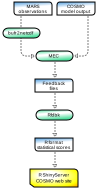
The most striking advantages of the new verification system that is proposed to be adopted for CP preparation activity, are the shortfall of data pre-processing (all data in one place, observation and forecast correctly assigned to each other, quality control done by data assimilation, small files), the fast and simple calculation of standard verification scores and the interactive browsability and online production of results. The main components of the code are analysed below and a schematic diagram of the system is also provided.
The MEC-Rfdbk verification system is based on the use of feedback files. Feedback files (FF) hold information on observations and their usage in the data assimilation (DA) system and are available for each observation system used in DA. They contain information regarding the observations (including meta-data) and corresponding model analysis, first-guess and past forecast (also ensemble) in the NetCDF format. Information from these files can be used for verification tasks (e.g. name, location, level, weight in DA, ensemble spread, talagrand index and so on).
Feedback files have a relatively small size (e.g. 4.8Mb SYNOP for COSMO-7km run for the NWP Test Suite domain) and are produced as one file for each valid-time (time window), model and observation system. The FF are produced by the Model Equivalent Calculator (MEC) within the data assimilation system or as stand-alone.
applies the observation operators from the data assimilation scheme (Nudging, 3Dvar, Ensemble Kalman Filter) to model forecasts (COSMO, ICON) and stores the results in verification files (NetCDF feedback file format). Observation operators are either those implemented in the DWD global data assimilation code (3dvar/EnVar/LETKF) or those implemented in the COSMO model, as used in the nudging and in the KENDA/LETKF data assimilation scheme. The results of MEC are stored in the NetCDF feedback file. The data assimilation code (3Dvar/EnVar/LETKF/KENDA) already writes the observational data (observed values, metadata, coordinates, etc.) and the analysis data (first guess and analysed values, quality control and data usage flags) in this format. In this case MEC takes these files as input, copies them to the output directory, replaces the file name prefix cof, mon, ekf by ver, and appends the model equivalents of forecasts with larger lead time.
Alternatively the fof-files (feedback file format as well) written by COSMO (in the nudging mode or in the first guess run for KENDA) may be taken as input for MEC. A further option is to use the original observational data (CDFIN, i.e. BUFR format converted to NetCDF). In these cases verification files will be generated separately for each observation type (TEMP, PILOT, SYNOP, etc). For this project, this second approach will be adopted by using a common set of observations (e.g. bufr data retrieved from ECMWFs mars archive), converting them in NetCDF format and using them as input in MEC.
MEC characteristics
and requirements:
Installation:
IO specifications:
While it is not the purpose of the CARMA PP, if the needed input is available, MEC can produce feedback-files for any model (including IFS), which can then be used as input to produce verification statistics using Rfdbk. As an example, DWD already produce IFS feedback-files (at ECMWF), using the DWD own set of observations. Alternatively, IFS feedback-files can be produced with any observation set by the interested users.
is an R-based code of useful functions that have been developed aiming to exploit the information contained in feedback files. The package allows: to load FF content (partially, parallel), to calculate basic verification scores (deterministic & EPS) and to perform some convenience functions like data adjustment, re-labeling, binning etc. Rfdbk exploits the functionality of the R data.table format and can therefore handle huge data tables efficiently with a concise syntax that allows to apply functions on sub-categories. Rfdbk itself is not a verification package but an assortment of R function. Base on Rfdbk there exists R scripts to quickly and reliably produce verification results. These scripts can be modified and adjusted according to the needs of each particular system that will be linked to.
Rfdbk characteristics
and requirements:
Installation:
According to the presentation that was given during GM2017 by F. Fundel (DWD), Rfdbk development is in the following stage:
On top, an interactive (R based) tool for the online visualization of verification results has been developed and will be also adopted in this project. This is based on the R Shiny web server that is currently setup on the COSMO web-site for the NWP Test suite needs. Through this capability it is possible to have on demand interactive plot web browser application, plot and arrange scores, summary score charts and browse data, with separate web based apps for each observation and verification type.
The migration to the new verification system that is proposed to be adopted for the CP preparation activity will be divided in three phases: training and implementation, testing and validation and CP production.
Because MEC-Rfdbk verification system is meant to be implemented by all the member countries in the consortium, a Project Support Team (PST), from NMA and HNMS, will ensure and support the implementation of the system for all the other partners. Additionally, a document for verification task specifications (common areas, models, parameters, statistical indices) included in CP activity will be prepared and the final product of the project will be based on the fulfilment of the preparation of the statistical information described inside it. The content of the CP activity is decided on an annual basis in the WG meeting during COSMO General Meetings.
The training and implementation phase will be done in two steps. First, a training (preferably @DWD) for both MEC and Rfdbk will be provided by DWD experts to the PST, including installation and run of a complete cycle of model evaluation for a test case over the CP area (including visualization of results with Shiny). This training will help the PST to implement MEC-Rfdbk system @NMA and @HNMS (with support from DWD if necessary), similar to the ones that will be installed in all participating countries. All necessary documentation for best installation and use practices will also be prepared.
The PST will also be responsible to prepare a complete example set of data (one season, one model). This data set will include model output and observations in the format required by the MEC-Rfdbk system, containing the parameters which are part of CP requirements. It is intended that, once the operational CP SPRT activity has adopted the migration from VERSUS to MEC-Rfdbk as verification framework, the observations necessary for this activity will be prepared on a seasonal basis by the same team in order to be used by all the COSMO countries.
Moreover, the PST will be responsible to develop and test scripts following the CP requirements defined in Task 1.1, which will later be provided to the other participants. These scripts will be used to produce the necessary statistical information according to the CP requirements.
After the MEC-Rfdbk system has been installed and tested by the PST (including provision of the necessary data set for validation), project activities will proceed with the second step of implementation, which is aimed at all countries in the consortium. In a second phase, a remote support through email and forum will be given from PST to all contact points of the participating services. Following these activities, the MEC-Rfdbk verification system will be locally implemented by all the member countries (NMS responsible person) in the consortium, with support from the PST and from DWD (the latter only when necessary, through the PST).
A web interface will be built/adapted on COSMO web server, by making use of Shiny R routines. This interface is intended to host CP activity outputs once the system becomes operational and will also be used during the next phases of the PP activities, for the visualization and evaluation of the statistical results obtained with the MEC-Rfdbk verification system. As this application is interactive, all users will be able to generate graphs that will be based on their model outputs over the common domains.
During the second phase of the project, after implementation in all the member countries, testing of the new MEC-Rfdbk verification system by each national service will be achieved through practical use (cross validation). A complete seasonal test (with all the necessary output for the CP reports) will be performed by the NMSs responsible persons. For this test, the data and scripts developed and provided by the PST in the first phase of the Project will be employed. The visualization of statistical results (R tables obtained with Rfdbk) will be achieved using the web interface on the COSMO server previously mentioned. A cross validation against VERSUS (or other verification system, depending on each institution’s strategy) will also be performed, using the same test data (period).
Finally, in order to enable the use of the MEC-Rfdbk system for CP activities (including seasonal verification), a series of procedures (scripts adaptation to local DBs) will be developed by all services. These procedures will be tested and evaluated for CP verification activities for a season. NMS will prepare the MEC output files based on their models for JJA 2018 season while PST will be responsible to run Rfdbk (on a central machine) and produce the statistical tables. The visualization of results obtained by will be possible on the COSMO web server (user and password access).The project will also provide a guidelines document on the implementation, use and application of the MEC-Rfdbk system for CP production.
DWD can provide support only for installation of MEC and Rfdbk in the "as-is-versions concerning both software and documentation, i.e. in the way it is implemented now at DWD.
Finally, while the opinion of members from the STC to include EPS verification is taken into consideration, the present proposal is focused primarily on replacing the existing VERSUS verification software environment with the MEC-Rfdbk software developed by DWD, as a CVS, in order to perform the CP activity in COSMO (deterministic models monitoring). As previously mentioned, the MEC-Rfdbk system is also suitable for EPS verification. After a successful completion of the current project proposal, EPS verification issues will be considered separately in a next phase (e.g. within the framework of a new PP/PT), after consideration and discussion between wgVA and wgEPS.
The restriction to the "as-is-version implies the following technical requirements for installing and running MEC and Rfdbk:
If different software/library versions are used by the various services, then they hold the responsibility to adapt the installation files.
Due to the distributed nature of the project participation team, administrative activities will be included in this task, in order to maintain a good collaboration and information flow between all participants (regular web conferences, workshops, etc.). A mailing list for the project will be used in order to support communication and information exchange between project participants.
Deliverables
Project coordination, meetings, preparation of plans/reports, workshops and regular web conference organization.
Contributors
A. Iriza-Burca (NMA): 0.2FTE
Duration
12.2018 - End 08.2021/p>
total FTEs
0.3 FTEs (originally planned, 0.2)
used FTEs
0.16 FTEs, remaining: 0.14 FTES
As the system will be implemented by all the member countries in the consortium, a first level support implementation and training of the PST will be included, who will, in turn, ensure and support the implementation of the system for all the other partners.
Note:Since it was decided to duplicate the existing shiny platform also used for the NWP Test Suite, FTEs for task 1.7 were left unused. (0.025FTEs moved to task 3.6)
period
Start 12.2018 - End 06.2019
total FTEs
0.755 FTEs (originally 0.78, but 0.025 FTEs moved to task 2.1)
Preparation of a document for verification task specifications (common areas, models, parameters, statistical indices, representation) included in CP activity. The content of the CP activity is decided on an annual basis from WG members during General Meeting but it will be enriched with more representation possibilities following Rfdbk features (e.g. cross model, choice of station stratification, etc.).
period
Start 12.2018 - End 01.2019
contributors
A. Iriza-Burca (NMA): 0.05FTE, F. Gofa (HNMS): 0.05FTE
total FTEs
0.1 FTEs
Documentation preparation (MEC-Rfdbk) with all the necessary installation and use notes for the PST training.
period
Start 01.2019 - End 02.2019
contributors
F. Fundel (DWD): 0.05FTE, R. Potthast, E. Bauernschubert (DWD): 0.05FTE
total FTEs
0.1 FTEs
Preparation of a complete example set of data (one season, one model) to be used during the training and testing period. Model output as a test bed, including parameters that are part of CP requirements will be prepared. Adaptation of observations in NetCDF format (with bufr2netcdf COSMO software). When CP activity through MEC-Rfdbk will be part of support activity, the seasonal observations necessary for CP activity will be prepared by the same team and will be disseminated to other COSMO countries.
period
Start 01.2019 - End 02.2019
contributors
B. Maco (NMA): 0.075FTE
total FTEs
0.075 FTEs
Training provided by DWD experts for first level support to the PST that will include A. Iriza-Burca, B. Maco and F. Gofa. During this training, a "clean installation of MEC, Rfdbk and Shiny routines for visualization of results will be performed on a test machine. A complete cycle of model evaluation for a test case (outcome of Task 1.3) over CP area will be performed (observation preparation, run of MEC for Feedback files preparation, run of Rfdbk for extraction of statistical indices for both continuous and dichotomic parameters, visualization of results with Shiny).
period
Start 03.2019 - End 03.2019
contributors
A. Iriza-Burca (NMA): 0.020FTE, B. Maco (NMA): 0.020FTE, F.Gofa (HNMS): 0.020FTE, D. Boucouvala (HNMS): 0.020FTE, F. Fundel (DWD): 0.05FTE, R. Potthast, E. Bauernschubert (DWD): 0.05FTE
total FTEs
0.18 FTEs
Implementation of the MEC-Rfdbk system @NMA and @HNMS. PST will have the Task to set-up systems similar to the ones that have to be installed from all participating countries with support from DWD experts if problems arise.
period
Start 03.2019 - End 05.2019
contributors
A. Iriza-Burca (NMA), 0.05FTE, B. Maco (NMA): 0.05FTE, F. Gofa, (HNMS): 0.05FTE, D.Boucouvala (HNMS): 0.05FTE, F. Fundel (DWD): 0.02FTE, R. Potthast, E. Bauernschubert (DWD): - 0.02FTE
total FTEs
0.24 FTEs
Adaptation of scripts to produce the necessary statistical information for the production of the CP requirements, on a seasonal basis. Preparation and testing of scripts for semi-automatic use of the system.
period
Start 05.2019 - End 02.2020
contributors
A. Iriza-Burca (NMA) - 0.05FTE, F. Fundel (DWD) - 0.01FTE
total FTEs
0.06 FTEs
Setup of web interface with the use of Shiny R routines on COSMO server to host CP activity outputs once the system becomes operational.
period
Start 05.2019 - End 03.2020
contributors
T. Andreadis (HNMS): 0.015FTE, B. Maco (NMA) - 0.01FTE
total FTEs
0.025 FTEs
deliverables
Implementation of the MEC-Rfdbk system by all the member countries in the consortium, with support from PST. DWD support will be provided only when necessary and always through the PST.
period
Start 06.2019 - End 04.2020
Total FTEs
1.125 FTEs (originally 0.9, 0.025 FTEs from task 1.7)
Used FTEs
0.71 FTEs, remaining: 0.415 FTEs
Remote training PST for users from each center. Dissemination of instructions, mailing list creation for problems solving, videoconferences, etc.
Note: Due to various issues encountered for the installation of the system (and use with the COSMO model), PST activities were entirely taken over by NMA (PL and Mr. B. Maco).
period
Start 06.2019 - End 08.2021
contributors
A. Iriza-Burca & B. Maco (NMA) 0.35 FTE, F. Fundel (DWD) 0.025 FTE, T. Andreadis (HNMS) 0.05 FTE
total FTEs
0.45 FTEs (originally 0.2, 0.025 reassigned from task 1.7)
used FTEs
0.16 FTEs, remaining:0.165 FTEs
Implementation of MEC-Rfdbk system in each participating center with support of PST. Almost all participants have finished the task, Rfdbk implementation still on-going in some centers.
period
Start 06.2019 - End 11.2020
deliverables
system installed by all project participants with support from PST.
contributors
P. Kaufmann, A. Pauling (MCH), F. Batignani (CNMCA), J. Linkowska (IMGW-PIB), A. Kirsanov (RHM), I. Carmona (IMS), M.S. Tesini (ArpaE), N. Vela (Arpa-PT) = 0.7 FTE (0.1 FTEs each)
total FTEs
0.7 FTEs
used FTEs
0.55FTEs, remaining: 0.15 FTEs
Testing of the verification system implementation and training through practical use
period
Start 03.2020 - End 08.2020
total FTEs
2.46 FTEs (originally 1.73, 0.73 added)
used FTEs
0.57 FTEs, remaining: 1.89 FTEs
Performance of a complete seasonal test with all the necessary output for the CP reports. This task will include development/adaptation of automatic procedures (scripts adaptation to local DBs) for seasonal CP activities based on the MEC-Rfdbk system by all services. Scripts to run MEC-Rfdbk are provided from Task 1.6.
period
Start 03.2020 - End 08.2020
contributors
F. Fundel (DWD), P. Kaufmann, A. Pauling (MCH), F. Batignani (CNMCA), D. Boucouvala (HNMS), A. Iriza-Burca (NMA), J. Linkowska (IMGW-PIB), A. Kirsanov (RHM), I. Carmona (IMS), M.S.Tesini (ArpaE) =1.26FTEs (0.14FTEs each); N. Vela (Arpa-PT) 0.10 FTE
total FTEs
0.46 FTEs (originally 1.36, 0.9 were moved to task 3.4)
Transfer to statistical output to COSMO web server and visualization of results through installation of Shiny server (capability developed in Task 1.6) for comparison purposes.
period
Start 03.2020 - End 08.2021
contributors
T. Andreadis (HNMS): 0.065FTE, B. Maco (NMA): 0.065FTE
total FTEs
0.13 FTEs
used FTEs
0.05 FTEs, remaining 0.06 FTEs
Optional comparison of test output with VERSUS or any other 'home' verification system.
Note: Some of the participants have already finished tasks 3.1 and 3.3 (NMA, DWD, IMGW), while some work is on-going (CNMCA). First results are presented during the on-line PP CARMA parallel session and the plenary session. Given the interest of participants in migrating to ICON and the delay in these tasks, we propose to freeze them and move the remaining FTEs from tasks 3.1 and 3.3 to the new task 3.4.
period
Start 04.2020 - End 08.2020
deliverables
Evaluation of MEC-Rfdbk system for CP production based on an example dataset. Comparison with results from other verification software.
contributors
P. Kaufmann, A. Pauling (MCH), F. Batignani (CNMCA), D. Boucouvala (HNMS), M. Bogdan (NMA), J. Linkowska (IMGW-PIB), A. Kirsanov (RHM), I. Carmona (IMS), M.S. Tesini (ArpaE): 0.24 FTEs (0.03FTEs each)
total FTEs
0.06 FTEs (originally 0.24, 0.18 FTEs are moved to task 3.4)
Set-up of system and performance of a test with all the necessary output of ICON-LAM for the CP reports. This task has been added due to the requirements of the participants, in view of the new ICON implementations. Some centers are unable to verify COSMO because of MEC model data requirements and lack of storage resources (e.g. not all required model data are archived). This additional sub-task also takes into consideration the migration from COSMO to ICON.
Note: Some of the FTEs for this task are obtained by redirecting planned resources from tasks 3.1 and 3.3.
period
Start 10.2020 - End 08.2021
contributors
NMSs responsible person = 1.12 FTEs (0.14 each) A. Iriza-Burca, B. Maco, M. Bogdan (NMA) = 0.24 FTEs (incl. ICON global) F. Fundel (DWD) = 0.05 FTEs
total FTEs
1.41FTEs, of which 0.90 FTEs from task 3.1 + 0.18 FTEs from task 3.3.
additional: 0.33 FTEs
At the moment, the shiny server on the COSMO web-site is used for visualization of results from Rfdbk (CP verification, NWP test suite). The set-up of individual shiny servers for each interested center would be advised, to facilitate the visualization of the verification results and avoid loading the COSMO shiny server unnecessarily.
Similar to the implementation of the MEC+Rfdbk system, the shiny server should first be set-up for the PST team (NMA, with support from HNMS), who will, in turn help the other participants set-up their own systems.
Note: This task is optional.
period
Start 10.2020 – End 08.2021
deliverables
contributors
NMSs responsible person = 0.4 FTEs ( 0.05 FTEs each) / optional
total FTEs
0.4 FTES (optional), additional: 0.4 FTEs
Preparation of documentation on the use of the MEC-Rfdbk system (including CP activities specifications)
period
Start 08.2020 - End 08.2021
deliverables
Guidelines on the implementation, use and application of the MEC-Rfdbk system for CP production
contributors
A. Iriza-Burca (NMA) - 0.05FTE, F. Gofa (HNMS) - 0.03FTE
Total FTEs
0.08 FTEs
After the successful completion of the project and based on the experience gained by the participants, wgVA will evaluate the necessity of a follow-up project to proceed with additional components of verification (e.g. EPS, spatial verification approaches) based on Rfdbk package features developed by DWD.
Furthermore, additional developments and applications of MEC-Rfdbk by the COSMO members beyond CP after the completion of PP CARMA are desirable but implementation and support, would require a re-assessment of resources, responsibilities and technical as well as organisational constraints which will be discussed in wgVA and decided by the STC.
DWD
F. Fundel, R. Potthast and E. Bauernschubert
MCH
P. Kaufmann, A. Pauling
CNMCA
F. Batignani
HNMS
F. Gofa, T. Andreadis and D. Boucouvala
IMGW-PIB
J. Linkowska
NMA
A. Iriza-Burca, B. Maco and M. Bogdan
RHM
A. Kirsanov
IMS
I. Carmona
ArpaE
M.S. Tesini
Arpa-PT
N. Vela
F. Gofa (2016)
COSMO Verification Overview
38th EWGLAM and 23th SRNWP Meeting, Rome, 03-06 October 2016
F. Gofa, U. Pflüger, X. Lapillonne, A. Vocino, D. Boucouvala, J. Linkowska,
R. Dumitrache, A. Bundel, M.S. Tesini, E. Oberto, Y. Levi (2015)
Recommendations: Strategy on Verification Tools
August 2015
wgVA (2015)
Recommendations: Strategy on Verification Tools
September 2015
Rhodin (2015)
MEC Manual
DWD documentation
Supplementary Documentation
Feedback-file definition
DWD, June 2012
| Task | Contributing scientist(s) | FTE-years | Start | Deliverables | Date of delivery | Preceding tasks |
|---|---|---|---|---|---|---|
| 0 | A. Iriza-Burca (NMA) | 0.2 FTE | 01.12.2018 | Project coordination, meetings, preparation of plans/reports, workshops and regular web conference organization. | 30.09.2020 | N/A |
| 1.1 | A. Iriza-Burca (NMA), F. Gofa (HNMS) | 0.1 FTE | 1.12.2018 | Documentation review, analysis of resources required. Document for experiment specifications included in CP activity. |
31.01.2019 | - |
| 1.2 | F. Fundel, R. Potthast and E. Bauernschubert (DWD) | 0.1 FTE | 1.01.2019 | Documentation preparation (MEC-Rfdbk) for the PST team training. | 28.02.2019 | 1.1 |
| 1.3 | B. Maco (NMA) | 0.075 FTE | 1.01.2019 | Data for a test period experiment. Model output including parameters that are part of CP requirements. |
28.02.2019 | 1.1 |
| 1.4 | A. Iriza-Burca, B. Maco (NMA), F. Gofa, D. Boucouvala (HNMS), F. Fundel (DWD), R. Potthast and E. Bauernschubert (DWD) | 0.18 FTE | 1.03.2019 | Training for PST - "clean installation of MEC-Rfdbk on a test machine and complete cycle of model evaluation for a test case over CP area. | 31.03.2019 | 1.1, 1.2, 1.3 |
| 1.5 | A. Iriza-Burca, B. Maco (NMA), F. Gofa, D. Boucouvala (HNMS), F. Fundel (DWD), R. Potthast and E. Bauernschubert (DWD) | 0.24 FTE | 1.03.2019 | MEC-Rfdbk implemented @NMA and @HNMS | 31.05.2019 | 1.1, 1.2, 1.3, 1.4 |
| 1.6 | A. Iriza-Burca (NMA), F. Fundel (DWD) | 0.06 FTE | 01.05.2019 | Scripts to produce the statistical information for the production of the CP on a seasonal basis. Procedures (scripts) for (semi-) automatic use of the system. |
28.02.2020 | 1.1, 1.2, 1.3, 1.4, 1.5 |
| 1.7 | T. Andreadis (HNMS), B. Maco (NMA) | 0.025 FTE | 01.01.2020 | Web interface with the use of Shiny R routines on COSMO server to host CP activity outputs once the system becomes operational | 31.03.2020 | 1.1, 1.2, 1.3, 1.4, 1.5 |
| 2.1 | A. Iriza-Burca, B. Maco (NMA), F. Gofa, D. Boucouvala (HNMS) | 0.2 FTE | 01.06.2019 | Remote training by PST for users from each centre. Dissemination of instructions, mailing list for problems solving. |
30.04.2020 | Task 1 |
| 2.2 | NMS responsible person F. Batignani (CNMCA), J. Linkowska (IMGW-PIB), A. Kirsanov (RHM), I. Carmona (IMS), M.S. Tesini (ArpaE), N. Vela (Arpa-PT) |
0.7 FTE | 01.06.2019 | Implementation of MEC-Rfdbk in each centre | 30.04.2020 | Task 1 |
| 3.1 | F. Fundel (DWD), P. Kaufmann, A. Pauling (MCH), F. Batignani (CNMCA), D. Boucouvala (HNMS), A. Iriza-Burca (NMA), J. Linkowska (IMGW-PIB), A. Kirsanov (RHM), I. Carmona (IMS), M.S. Tesini (ArpaE), N. Vela (Arpa-PT) | 1.36 FTE | 01.03.2020 | Seasonal test with all the necessary output for the CP reports. | 31.08.2020 | Task 1, Task 2 |
| 3.2 | T. Andreadis (HNMS), B. Maco (NMA) | 0.13 FTE | 01.03.2020 | Visualization of results through the capability developed in Task 1.6. | 31.08.2020 | 3.1 |
| 3.3 | P. Kaufmann, A. Pauling (MCH), F. Batignani (CNMCA), D. Boucouvala (HNMS), M. Bogdan (NMA), J. Linkowska (IMGW-PIB), A. Kirsanov (RHM), I. Carmona (IMS), M.S. Tesini (ArpaE) | 0.24 FTE | 01.04.2020 | Comparison of CARMA output with VERSUS system or any other "home verification system | 31.08.2020 | 3.1, 3.2 |
| 4 | A. Iriza-Burca (NMA), F. Gofa (HNMS) | 0.08 FTE | 01.08.2020 | Guidelines on the implementation, use and application of the MEC-Rfdbk system | 30.09.2020 | Task 1, Task 2, Task 3, Task 4 |
| All | 3.730FTE | 01.12.2018 | 30.09.2020 | |||
Deliverables of PP CARMA have been delayed due to unprecedented conditions caused by COVID-19. Work is on-going in successfully finishing the final 2 Tasks of the project. However, despite the considerable effort from the contributing scientists, communication impediments and difficulties in maintaining work flow have been unavoidable.
Apart from this unforeseeable situation, requirements from the participating scientists with regards to their verification needs have led to the necessity of shifting the main task of the project from COSMO to ICON, in view of the COSMO to ICON migration.
As a consequence, there is a need to include two additional sub-tasks in the current project plan and extend the project management and support tasks. While task 4, dedicated to preparation of guidelines for the use of the system will go on as planned (only timeline is proposed to change for this task), sub-tasks 3.1 and 3.3 should be replaced by a new sub-task 3.4 dedicated to ICON issues.
This additional sub-task is directly related to the COSMO to ICON migration and the need to test the new verification system for ICON-LAM implementations, rather than continue to invest much effort in adapting it for COSMO needs. As previously mentioned, this addition of the ICON-related sub-task also leads to an additional extension of the support task and administrative activities. It is important to emphasize that, due to requirements of the participants, some of the work in the additional task 3.4 has already been done. Also, a considerable amount of FTEs from tasks 3.1 and 3.3 is left unused at the moment and can instead be invested in efforts related to issues concerning verification of ICON (task 3.4).
Apart from this, an optional sub-task is also proposed, which was not foreseen at the beginning of the project. The current shiny server (COSMO web) is used for both CP activities and the NWP Test Suite verification platform. Set-up of individual shiny servers would be advised, in order to avoid loading the COSMO shiny server unnecessarily.
As a consequence, a one-year extension is proposed. For this purpose, an amount of unused 1.105 FTEs has been moved to the new tasks and an amount of maximum 1.03 additional FTEs is requested for the extension of the project. Besides lower efficiency due to the COVID-19, the FTEs requested stand for additional activities, including support and testing of the verification system for ICON-LAM.
| Task | 0 | 1 | 2 | 3 | 4 | |||||
|---|---|---|---|---|---|---|---|---|---|---|
| 2.1 | 2.2 | 3.1 | 3.2. | 3.3 | 3.4 | 3.5 | ||||
| Status/Extended | Yes 08.2021 |
end | Yes 08.2021 |
Yes 11.2020 |
remove | Yes 08.2021 |
remove | New 08.2021 |
New 08.2021 |
Yes 08.2021 |
| Total FTE previously |
0.2 | 0.780 | 0.2 | 0.7 | 1.36 | 0.13 | 0.24 | - | - | 0.08 |
| Total FTE current |
0.3 | 0.755 | 0.425 | 0.7 | 0.46 | 0.13 | 0.06 | 1.41 | 0.4 | 0.08 |
| Used | 0.14 | 0.755 | 0.16 | 0.55 | 0.46 | 0.05 | 0.06 | 0 | 0 | 0 |
| Remaining to be done |
0.16 | 0 | 0.165 | 0.15 | 0 | 0.08 | 0 | 1.41 | 0.4 | 0.08 |
| Additional (New) | 0.1 | - | 0.2 | - | - | - | - | 0.33 | 0.4 | - |
| Redistrib. (to another task) |
- | 0.025 (2.1) |
- | - | 0.9 (3.4) |
- | 0.18 (3.4) |
- | - | - |